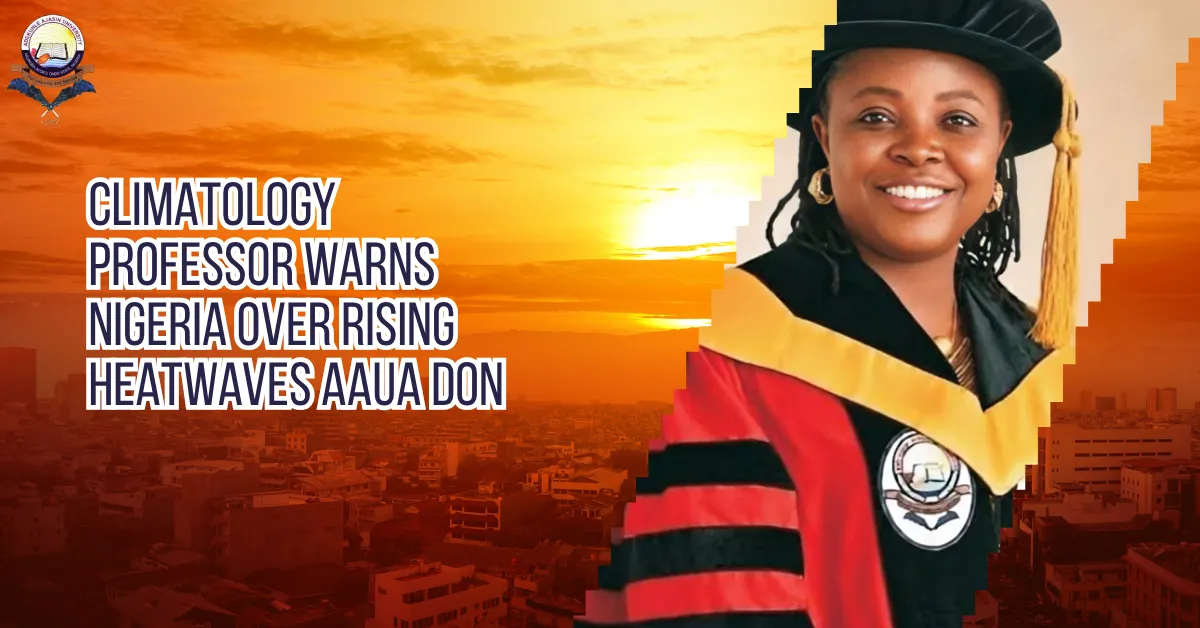
Nigeria risks deepening food insecurity, economic strain and public health crises unless governments adopt urgent climate adaptation measures, a Professor of Climatology at Adekunle Ajasin University, Akungba Akoko (AAUA), Ondo State, has warned.
Prof. Oyenike Eludoyin made the call while delivering the University's 68th inaugural lecture titled "The Human Element in the Climate Equation: Navigating Thermal Stress and Environmental Health in a Warming Nigeria."
Eludoyin described rising temperatures across the country as a "silent and invisible biological crisis," noting that heatwaves are not evenly distributed nationwide. Densely populated residential areas, commercial centres and heavily paved urban communities with little vegetation record higher temperatures due to poor ventilation, she explained, compared with surrounding rural and vegetated areas.
According to her, agriculture has already been hit hard, as farmers and farm labourers are often unable to work during peak daytime temperatures, resulting in lower productivity, reduced incomes and growing food security concerns. She added that prolonged high night time temperatures have disrupted sleep patterns and worsened public health outcomes, while the rising cost of artificial cooling systems is placing further financial pressure on households and deepening climate induced poverty.
"Nigeria must move swiftly from a passive posture of Climate Victimhood to an active stance of Climatic Agency," she stated. "The global climate is warming at a pace that severely outstrips our current infrastructural capacity. Concurrently, our local Nigerian environment is becoming more humid, less ventilated and progressively stressful to biological life."
Eludoyin noted that although many farmers have adopted coping strategies such as cultivar selection and microclimate modification, severe heatwaves and flash floods continue to threaten production, particularly among smallholder farmers. She called for the establishment of climate monitoring stations in all local government areas, sustained public enlightenment campaigns and subsidies for rural green technologies, alongside wider adoption of precision agriculture.
She further proposed that regional universities serve as climate hubs, producing digital planting calendars and farm advisory services in indigenous languages.
Vice Chancellor of AAUA, Prof. Tomola Obamuyi, who spoke earlier at the event, described the inaugural lecture series as one of the Institution's enduring academic traditions and commended Eludoyin's contributions to climate research.



Leave a Reply