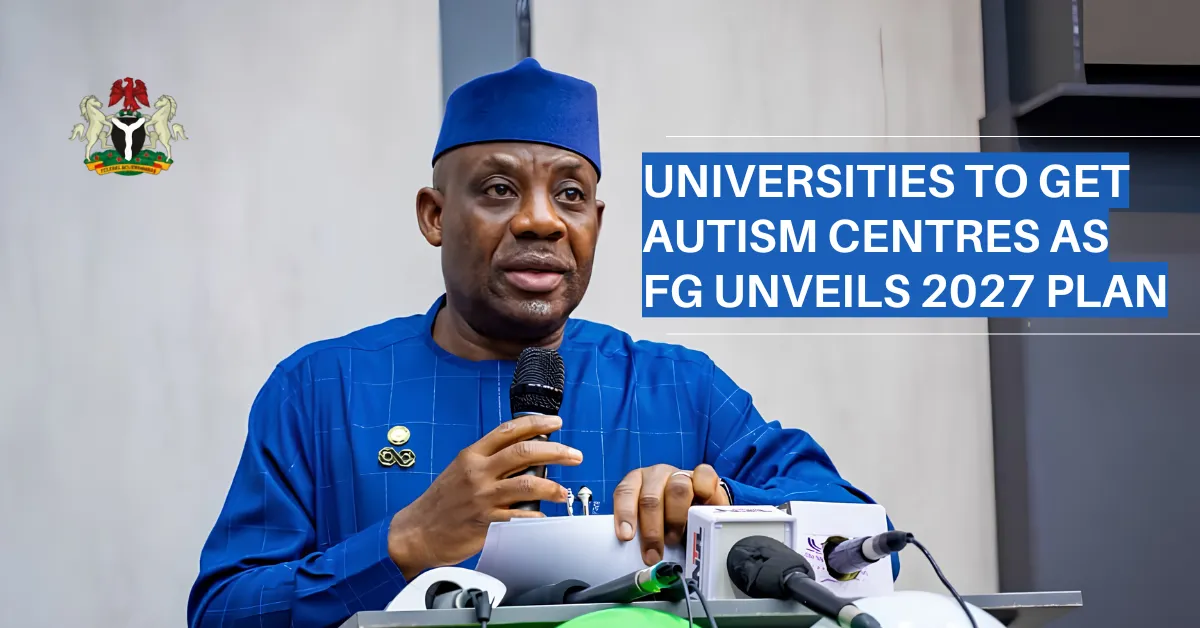
The Federal Government has announced plans to establish Autism Centres across the six geopolitical zones in 2027, aimed at strengthening autism care and expanding specialist training in universities nationwide.
Minister of Education, Dr Maruf Alausa, disclosed this during an engagement with stakeholders in Abuja on Wednesday, explaining that the centres would offer diagnostic, therapeutic, and research services while supporting families, healthcare professionals, and educational institutions.
According to the minister, the initiative addresses the shortage of professionals in audiology, speech and language therapy, and occupational therapy. He revealed that the number of universities offering these specialised programmes has grown from four to about 16 under ongoing reforms.
“The federal government, through the ministry of education is supporting this by expanding the number of institutions offering programmes in audiology, speech therapy and occupational therapy. We have moved from four universities to about 16 universities, but we want even more institutions to train the manpower needed to support these essential services,” he said.
Alausa noted that targeted interventions would commence in 2027 to strengthen universities running the specialised programmes, covering infrastructure expansion, modern equipment and instructional materials to boost training capacity.
He lamented that Nigerian families still travelled abroad to access specialised care for children with autism and Attention Deficit Hyperactivity Disorder due to limited local capacity.
“Today, many family still have to travel outside Nigeria to access care for their autistic children. This is not acceptable, and the federal government is determined to change that,” he said.
The minister further revealed that the ministry had directed the National Board for Technical Education to fast track accreditation of the Federal School of Occupational Therapy and the Occupational Therapy diploma programme at the University of Benin, Edo State, a move he said would create a seamless academic pathway from diploma to bachelor’s degree.
Alausa commended universities that had introduced the specialised programmes, calling their efforts vital to building the workforce required to improve care for children with developmental conditions.
He reaffirmed the ministry’s commitment to collaborating with universities, regulatory agencies and professional bodies to expand specialist training and promote research in autism care, adding that the initiative aligns with President Bola Tinubu’s Renewed Hope Agenda to improve access to diagnosis, therapy and inclusive education for children with autism, ADHD and other developmental conditions.


Leave a Reply