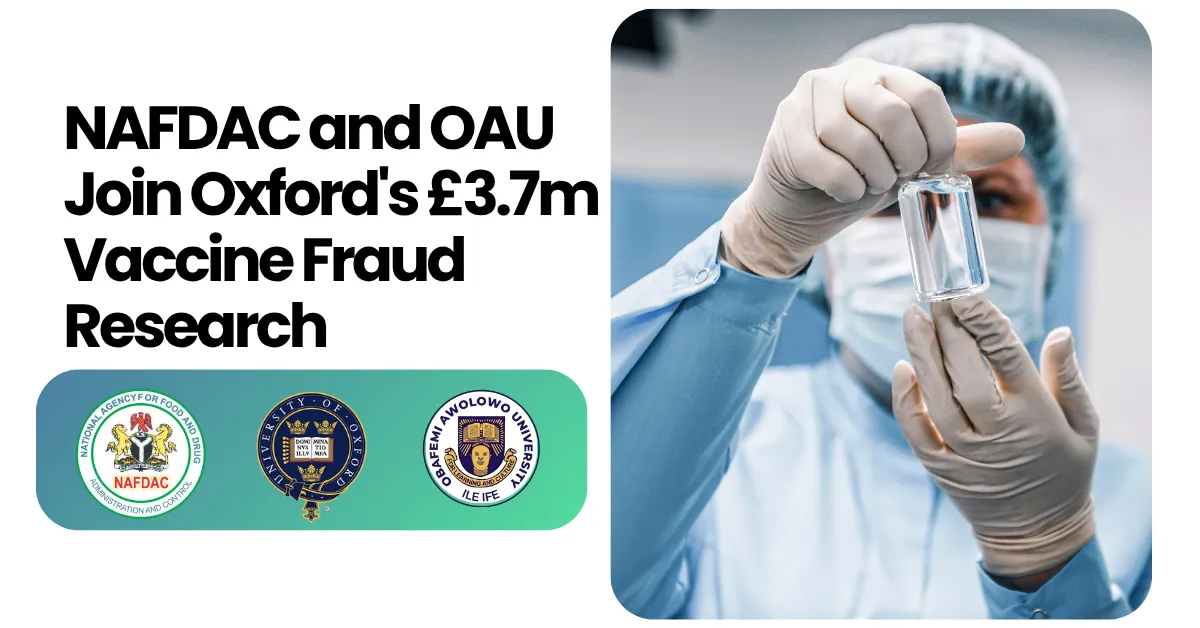
The National Agency for Food and Drug Administration and Control and Obafemi Awolowo University have joined a £3.7 million international research initiative led by the University of Oxford to develop technologies capable of detecting substandard, degraded and falsified vaccines across supply chains.
The NAFDAC Director General, Prof. Mojisola Adeyeye, announced the three year project, disclosing that it is funded under the United Kingdom's Medical Research Council Developmental Pathway Funding Scheme.
The consortium includes the UK Medicines and Healthcare products Regulatory Agency, the University of East London, the Mahidol Oxford Tropical Medicine Research Unit in Thailand, and several other international research institutions.
The initiative builds on the Vaccine Identity Evaluation Consortium, established during the COVID 19 pandemic to counter the global threat of substandard and falsified vaccines. Under the new phase, NAFDAC will lead vaccine quality surveillance in Nigeria through post marketing monitoring, laboratory evaluation of vaccine batches, testing of innovative screening technologies, and economic studies to identify the most cost effective verification methods.
"As Nigeria's National Regulatory Authority, NAFDAC will play a central role in implementing the project by strengthening vaccine quality surveillance and supporting evidence based regulatory decision making," the agency stated.
The grant also extends earlier research by the University of Oxford's Medicine Quality Research Group, which adapted advanced laboratory techniques to identify degraded and falsified vaccines within supply chains. The new phase will refine those technologies and test them under conditions that reflect real world vaccine distribution in Nigeria.
The project carries significant economic weight. The World Health Organization estimates that at least one in 10 medicines in low and middle income countries is substandard or falsified, with countries losing an estimated $30.5 billion annually to poor quality medical products. Nigeria alone spends approximately $150 million annually on vaccine procurement, according to Dr. Muyi Aina, Executive Director of the National Primary Health Care Development Agency.
The research is expected to strengthen immunisation programmes, reduce falsified vaccine circulation and rebuild public confidence in vaccination.
The announcement follows a series of enforcement actions by NAFDAC. In February, the agency confiscated over 10 million doses of fake malaria medicines and cosmetic products valued at approximately N3 billion at the Trade Fair Market in Lagos. In March, it destroyed fake and unwholesome drugs worth over N939 million in Awka, Anambra State.



Leave a Reply