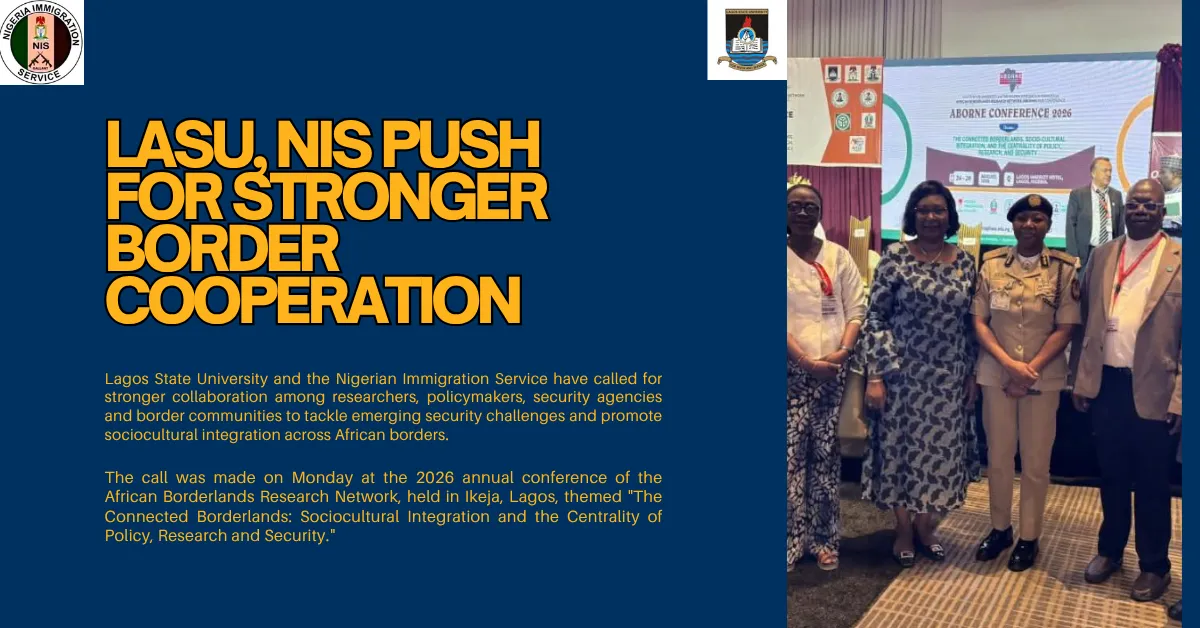
Lagos State University and the Nigerian Immigration Service have called for stronger collaboration among researchers, policymakers, security agencies and border communities to tackle emerging security challenges and promote sociocultural integration across African borders.
The call was made on Monday at the 2026 annual conference of the African Borderlands Research Network, held in Ikeja, Lagos, themed "The Connected Borderlands: Sociocultural Integration and the Centrality of Policy, Research and Security."
Speaking at the event, the Vice Chancellor of LASU, Professor Ibiyemi OlatunjiBello, described the gathering as an opportunity to promote research responsive to Nigeria's and Africa's realities, stating, "The theme invites us to look beyond the border as a line and to see the borderland as a living space where people, cultures, languages, markets, and histories intersect; where national interest meets regional aspirations; and where policy, research, and security must work together."
She noted that Lagos was a fitting host given its position along the Lagos Abidjan corridor, adding that LASU's commitment to border studies was reflected in its Bachelor of Arts programme in Border and Migration Studies.
In her address, the Comptroller General of the NIS, Kemi Nandap, disclosed that border management was undergoing significant transformation due to technological advancement, shifting migration patterns and emerging security threats, noting that traditional patrols and document checks were no longer sufficient to tackle human trafficking, smuggling and cyber enabled threats.
She stated that Nigeria had modernised its border systems through electronic passports, biometric verification and e gates, but stressed, "Technology cannot replace professionalism, experience, judgment, and the integrity of the officers entrusted with securing our borders."
The Senior Special Adviser on Policy to the Minister of Interior, Dr Kareem Oladokun, representing the Minister, said effective border management required stronger partnerships among government institutions, universities, security agencies and development partners, noting that border communities possessed valuable knowledge for early warning and conflict prevention.
Representing the Lagos State Governor, Babajide SanwoOlu, the Commissioner for Tertiary Education, Tolani Sule, said the conference underscored the importance of universities engaging with real world challenges, noting Lagos' relevance as Nigeria's economic and commercial hub.
The Chairman of ABORNE, Professor Paul Nugent, explained that the network was founded in 2007 by 12 scholars at the University of Edinburgh and had since grown into an international body linking research with policy across Africa's borderlands.



Leave a Reply