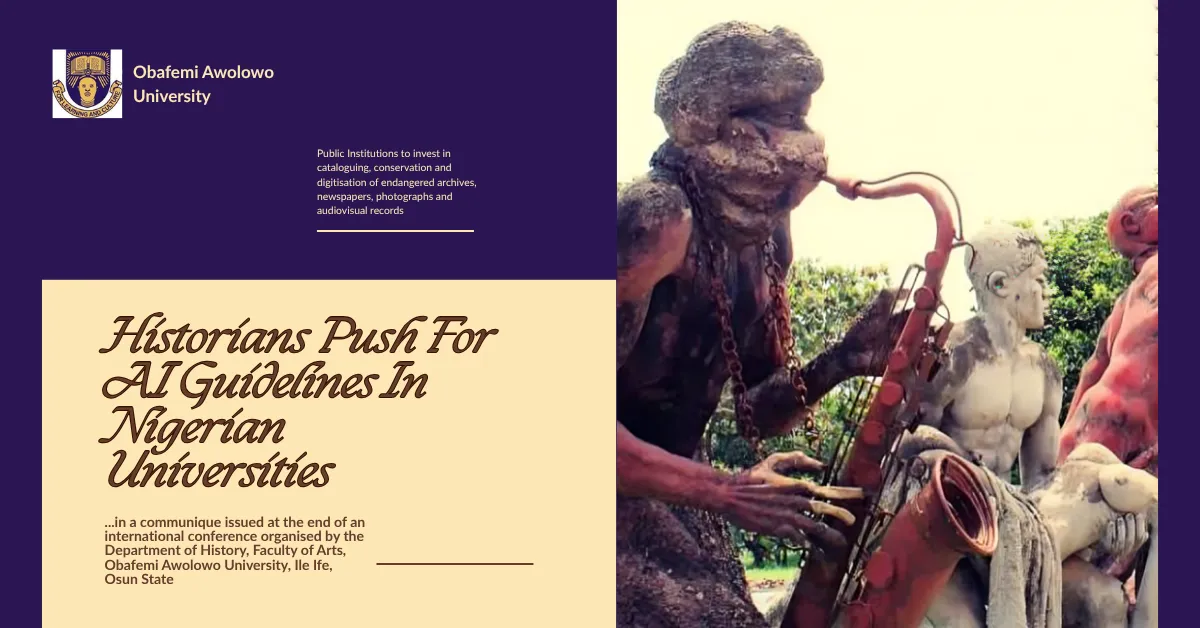
Historians and academics from Universities across Nigeria and beyond have called for clear guidelines on the use of artificial intelligence in historical research and teaching, warning that AI generated outputs could contain factual errors, fabricated references, and inherited biases.
The call was made in a communique issued at the end of an international conference organised by the Department of History, Faculty of Arts, Obafemi Awolowo University, Ile Ife, Osun State. The conference, themed "Futures of History", ran from Tuesday to Thursday last week, with participants examining issues including artificial intelligence, digital media, orality, performance, gender, Afrofuturism, colonial archives, security, Pan Africanism, higher education, environmental knowledge, and public history.
The communique, made available on Monday, was signed by the Co Secretary of the OAU International History Conference, Stephen Adewale, on behalf of participants and the organising committee.
While acknowledging that AI could enhance historical research through improved searches, transcription, and organisation of materials, the dons stressed that every quotation, date, citation, and factual assertion generated by an AI system must be verified against identifiable primary sources or reputable secondary scholarship before use. They recommended that universities and professional associations develop institutional guidelines covering ethical AI use, attribution, data protection, academic integrity, and disclosure of machine assistance.
The conference also urged governments, Universities and education authorities to strengthen history education at all levels, warning that weakening the subject could undermine public understanding of identity, institutions, and social change.
Beyond AI regulation, the historians called on Public Institutions to invest in cataloguing, conservation and digitisation of endangered archives, newspapers, photographs and audiovisual records, while urging researchers to document oral traditions, indigenous languages and private collections that have not been published online.
The communique further encouraged deeper public engagement through schools, museums, cultural institutions, and responsible digital platforms, and called on universities and funding bodies to support mentorship programmes and opportunities for early career scholars.
Participants included the Vice Chancellor of OAU, Prof. Adebayo Bamire, represented by the Dean of the Faculty of Arts, Prof. Gbenga Fasiku; the Head of the Department of History, Dr Shina Alimi; Prof. Abiodun Alao of the African Leadership Centre, King's College London; Prof. Tunde Decker of Osun State University; and Prof. Abimbola Adesoji, among others.
Leave a Reply