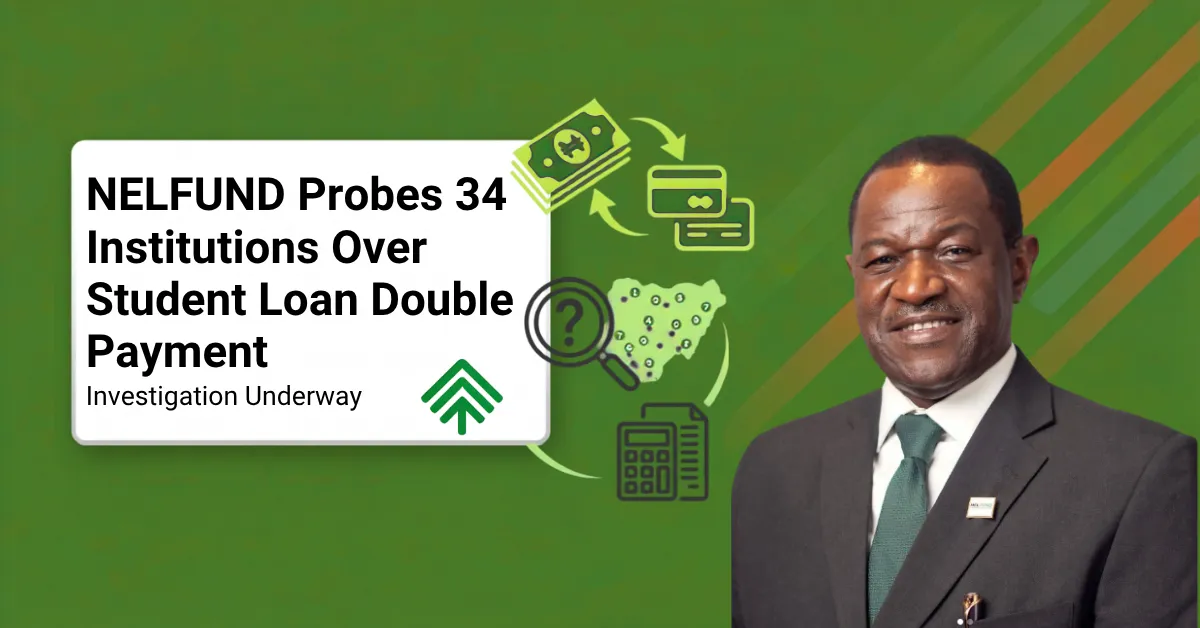
The Nigerian Education Loan Fund has launched investigations into 34 tertiary institutions accused of withholding refunds owed to students whose tuition fees were paid twice under the Federal Government's student loan scheme.
NELFUND's Managing Director, Akintunde Sawyerr, disclosed this during an interview with ARISE NEWS on Sunday, stating that the agency deployed a five man team comprising EFCC operatives, the National Association of Nigerian Students, internal auditors, and other stakeholders to the affected institutions following a surge in complaints from students.
"As of right now, there are 34 institutions that we are looking at closely with respect to this issue," he said.
Sawyerr traced the problem to a presidential directive ordering the scheme to commence midway through an academic session. Many students paid their tuition fees while awaiting loan approval, after which NELFUND settled the same fees directly with their institutions, creating duplicate payments.
"What happened is that a lot of schools got double payment. Some from the students, some from us. The refund process is entirely out of our hands. It is the recipient of the double payments that is obliged to make refunds to the students," he stated.
Many beneficiaries had borrowed money from relatives to meet registration deadlines and were depending on refunds to settle those debts. Sawyerr acknowledged that some institutions had responded promptly while others had not, though he stopped short of attributing deliberate wrongdoing. "Some have been very good at this. Others haven't been so good at it. I reserve judgment on the intentionality around it because, for some of them, they just didn't have the process to make refunds," he said.
To prevent a recurrence, NELFUND is developing a token based payment system under which students will hold tuition funds as digital tokens on their mobile phones and authorise payments directly at their institution's bursary. "We're looking at a tokenised system where the student has the funds effectively as a token on their telephone, and when they go to the bursary, they can effectively push a button that makes the payment, and then they're allowed to carry on with classes," Sawyerr said.
He confirmed that once the upgrade is complete, NELFUND will cease direct payments to institutions. The agency maintained that funds would not be transferred directly into students' bank accounts due to the risk of diversion.
Sawyerr admitted that NELFUND lacks legal authority to compel refunds or prosecute erring officials, noting that frustrated students had submitted petitions directly to the EFCC and the ICPC. He also revealed that some institutions raised tuition fees after the loan scheme launched, but NELFUND declined to approve the increases. "Some schools, because they get paid easily, started to put up their fees. We refused, point blank, to pay institutions who had hiked their fees beyond a certain level," he stated.
Since its launch in 2024, NELFUND has disbursed ₦206.29 billion in loans to over 1.16 million beneficiaries.



Leave a Reply